


If you've spent any time around vintage Rolex watches, you've probably seen it: a bracelet that once sat tight and neatly articulated has become loose, floppy and visibly "stretched".
It's commonly treated as an inevitable consequence of age.
It isn't quite that simple.
Watch bracelet stretch is primarily wear. And while time, contamination, bracelet construction and maintenance all play a part, one factor is often overlooked: how the watch is worn on the wrist.
In particular, allowing the watch to sit so far forward that the case or crown presses against the back of your hand can create surprisingly large forces through the bracelet every time you move your wrist.
What is bracelet stretch?
Despite the name, the steel links of a watch bracelet aren't normally stretching in the conventional sense.
What we perceive as "bracelet stretch" is predominantly the accumulation of wear and increased clearance between the components that make up the bracelet.
Pins, link interfaces and other bearing surfaces experience movement and loading over thousands of hours of wear. As material gradually wears at these interfaces, the bracelet develops more play.
A small amount at each connection might be almost imperceptible. Multiply it across an entire bracelet and you get the familiar loose, drooping appearance associated with a heavily worn bracelet.
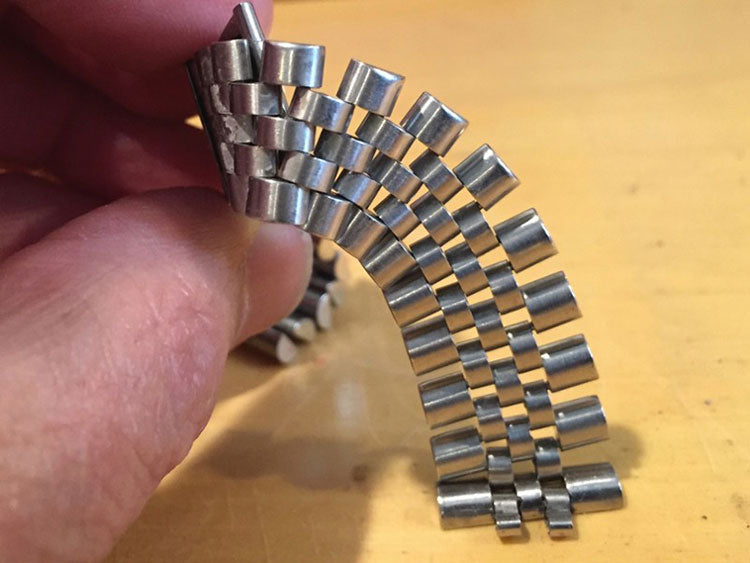
This is one reason two bracelets of similar age can have remarkably different amounts of stretch. Age alone doesn't tell the whole story.
The overlooked problem: your hand can become a lever
One of the easiest things to check is where your watch actually sits.
If your watch regularly slides towards your hand until the crown or lower edge of the case sits against the point where your hand bends backwards, you've created a mechanical pivot.

Now bend your hand backwards.
Instead of your hand simply moving independently of the watch, it contacts the case and begins pushing the entire watch head backwards.
The watch wants to move up your wrist. The bracelet is holding it in place.
Something has to take that load.
And that something is your bracelet.
Your hand is effectively acting as a lever against the watch case, generating tension through the bracelet every time you repeat the movement.
A simple test
Put your watch on as you normally would.
Now bend your hand fully backwards.
The crown and case shouldn't dig into the back of your hand.
You shouldn't be using your hand to push the watch head backwards, and you shouldn't finish with a pronounced crown imprint caused by the watch being levered against your skin.
As a rough guide, if this is happening, try moving the watch approximately 5–10mm further back up your wrist and repeat the movement.
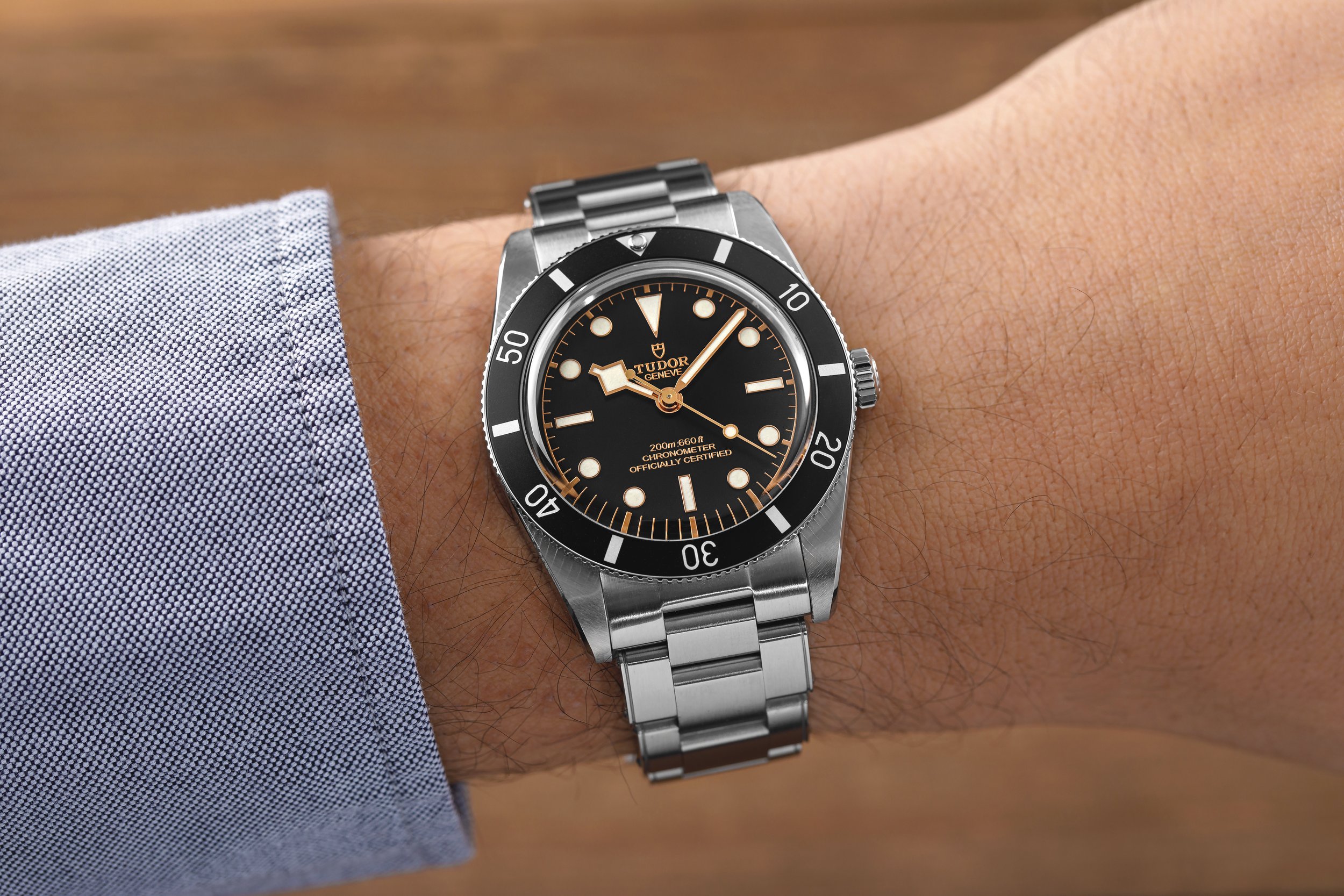
The exact position will vary with wrist anatomy, watch dimensions and personal preference. The important part isn't achieving a particular measurement.
It's removing the pivot.
Your hand should be able to articulate backwards without becoming a lever against the watch case.
If it keeps sliding forward, check your bracelet adjustment
Sometimes people deliberately prefer wearing a watch very close to the hand. That's personal preference.
But if you position your watch slightly further back and it repeatedly slides forward until the crown is against your hand, that's worth paying attention to.
Your bracelet may simply be too loose.
A correctly adjusted bracelet doesn't need to clamp tightly around your wrist, but it should generally control the position of the watch head rather than allowing a relatively heavy watch to travel freely backwards and forwards.
This is where good bracelet adjustment matters.
Half links, micro-adjustment and on-the-fly adjustment aren't only about comfort. They allow much finer control over bracelet circumference, making it easier to find a fit that is comfortable while still keeping the watch where you want it.
Think about how much force you're actually generating
It's easy to underestimate the loads involved because all you've done is bend your hand.
But leverage changes things.
Imagine a bracelet component that requires a meaningful pull with your fingers before it moves. If bending your wrist against the watch case can generate enough force to move that component, consider what is happening to every conventional link between the clasp and the watch head.
A normal bracelet link can't simply become longer when overloaded.
It has nowhere to go.
So that load is carried through its pins and contact surfaces. Repeated over months and years, loading and movement at those interfaces can contribute to the wear we eventually see as bracelet stretch.
It's particularly worth considering on valuable older bracelets, where preserving the condition of original components matters.
An unexpected benefit of SwiftLink
This produced an interesting observation during the development of our patent-pending Steel Reef SwiftLink.
SwiftLink replaces a conventional bracelet link while providing concealed incremental adjustment. Unlike every fixed link around it, however, it has the ability to extend when sufficient force is applied.
That means it can also become the one part of the bracelet capable of giving under an unusually high tensile load.
If you accidentally generate substantial leverage by trapping the watch against the back of your hand, a conventional bracelet has no intentional extension point. That force continues through the bracelet.
With SwiftLink installed, sufficiently high force can instead overcome the adjustment mechanism and allow the link to extend.
You might initially think:
"My SwiftLink just opened."
But there's another way of looking at what has happened.
The SwiftLink took the hit.
Rather than requiring the original bracelet links to carry the entire load, the adjustable link moved and relieved some of that tension.
We wouldn't suggest deliberately relying on SwiftLink as a bracelet protection device — the better solution is always to avoid generating the leverage in the first place — but it's an interesting secondary consequence of designing a link that can give where conventional links cannot.
Why don't we simply make SwiftLink much stiffer?
It's a reasonable question.
The resistance of an adjustable bracelet mechanism is a balancing act.
Make it too light and it can move too easily. Make it excessively stiff and several other things happen: adjustment becomes unpleasant, internal wear can increase, and the user has to pull considerably harder against the bracelet simply to operate it.
That last point matters.
Our objective isn't to create a mechanism that will resist any conceivable force applied to a bracelet. It's to provide enough resistance for normal wear while remaining comfortable and intuitive to adjust.
If an external load becomes high enough to overcome that resistance, simply increasing the resistance indefinitely isn't necessarily the right engineering solution. At some point you're simply ensuring that more of that force gets transferred elsewhere.
How should a watch bracelet fit?
There isn't one universally correct position or tightness. Wrist shapes differ, watches differ, and people have different preferences.
But from the perspective of bracelet mechanics, there are some useful principles:
-
The watch shouldn't move so freely that the head repeatedly slides onto the back of your hand.
-
The crown and case shouldn't routinely dig into your hand when you bend your wrist backwards.
-
Your hand shouldn't become a pivot that levers the watch against its bracelet.
-
The bracelet should be comfortable without allowing excessive movement of the watch head.
-
Fine adjustment is preferable to choosing between obviously too tight and obviously too loose.
The easiest test remains the simplest:
Put your watch where you normally wear it and bend your hand backwards.
If your hand immediately drives the watch head up your wrist, try moving the watch slightly further back.
If it feels better there but won't stay there, adjust the bracelet.
Bracelet stretch isn't just about age
A well-used mechanical watch will inevitably accumulate signs of wear. That's part of owning and enjoying one.
But not all wear is inevitable.
Keeping a bracelet clean, maintaining it appropriately, adjusting it correctly and paying attention to how forces travel through it can all influence how it ages. If your bracelet needs a finer fit, our Steel Reef collection of half links, extension links and SwiftLinks is a good place to start.
And sometimes something as simple as moving your watch 5–10mm further up your wrist can remove a source of leverage being repeated hundreds of times every day.
Your bracelet might thank you in twenty years.


